Sunday, 27 December 2020

Corporate Reorganization


Corporate reorganization involves restructuring the way a company works in an attempt to avoid double taxation scenarios, improve profitability, or increase the company’s efficiency. The corporate reorganization clause is a provision contained in a company’s charter. The endowment directs mergers and acquisitions, changes in assets or ownership structure, as well as changes in corporate control. The most common forms of corporate reorganization include mergers and amalgamations, financial restructuring, corporate buyouts, divestitures, etc. While many companies reorganize to improve efficiency and increase profits, others also pursue reorganization as a way of reviving a financially troubled business. The management of a company facing liquidation may make certain changes to its operations.

It is the corporate action in which a company buys most, if not all, of another company ownership stakes in order to assume control. Acquisition are frequently made as part of an enterprise’s growth strategy wherever it is more valuable to take over an existing firm’s operations and niche compared to expanding on its own. A merger is alike to an acquisition but mentions more severely to combining all of the interest of both companies into a stronger single company.

The changes may include entering into an agreement with creditors on debt repayments and restructuring the company’s capital structure or the assets and liabilities. The measures are part of the company’s reorganization geared towards extending the life of the financially — troubled company.

Objectives of Merger and Acquisition

  • Economies of scale
  • Reduction in production, administrative, selling, legal and professional expenses
  • Optimum use of capacities and factors of productions
  • Tax advantages (Carry forward and set off of losses)
  • Removing financial constraints for expansion
  • Diversification and competitive advantage
  • Revival of a week or sick company

Business Acquisition is the procedure of acquiring a company to build on strengths or weaknesses of the acquiring establishment.

Types of Business Reorganization:
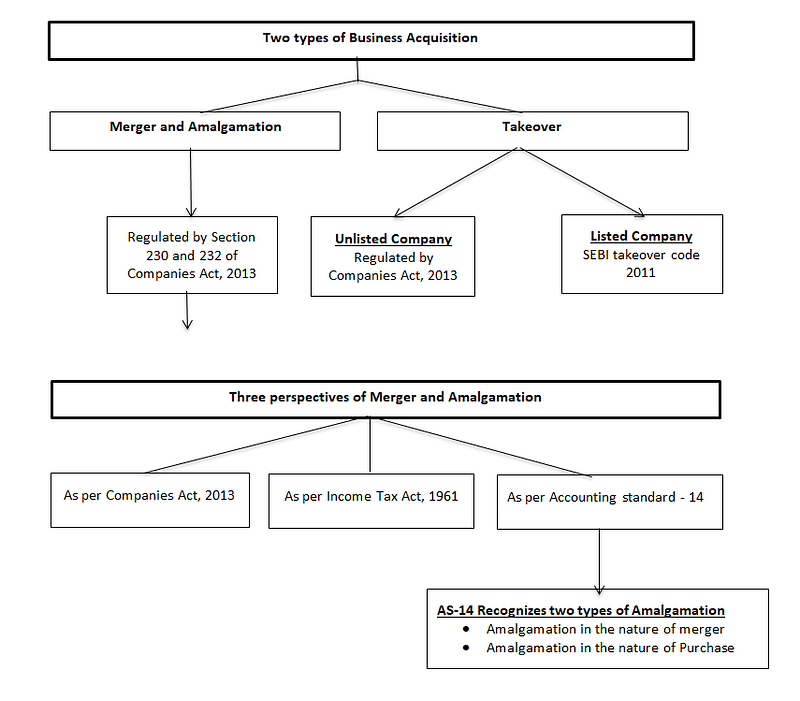
Amalgamation in the nature of merger
It affects a mode by which one company acquires another company’s assets and liabilities in such a way that, the equity shareholders of the combining entities continue to have a proportional share in the equity of the joint entity.

Amalgamation in the nature of purchase
It affects a mode by which one company acquires another company and hence, the equity shareholders of the combining entities do not continue to have an impartial share business of the acquired company is not intended to be continued after amalgamation.

Regulatory Framework of Merger & Amalgamation covers

  • The Companies Act, 2013
  • Companies (Compromises, Amalgamations, and agreements) Rules, 2016
  • Income Tax Act, 1961
  • Listing Regulations 2015
  • The Indian Stamp Act, 1899
  • Competition Act, 1899
  • FEMA
  • Banking Regulations Act, 1949
  • AS-14 Companies (Indian Accounting Standard) Rules, 2015

Difference between Amalgamation and Merger

MergerAmalgamationTwo or more companies who share parallel processes or are involved in the same line of business association to expand their services or diversify their activitiesA bigger and financially stronger entity takes over a smaller one

Horizontal, vertical, and conglomeration

Amalgamation is of two types:

· the nature of purchase and

· amalgamation in the nature of merger

Merger gives rise to a new entityThe acquiring company retains its identity while the acquired company’s identity is dissolvedThe shareholders of the companies who are parties to the merger become the shareholders of the new entityShareholders of the acquired company is added to the existing number of shareholders of the acquiring company

Legal Aspects of Merger and Acquisition

Application for making compromise and arrangement

Where a compromise or arrangement is proposed –

  • Among a company and its creditors or any class of them; or
  • Among company and its members or any class of them.

The tribunal may, on the application of the company or of any creditors or members of the company’s or in the case of a company which is being wound up, appoint the liquidator under this Act or may be under the insolvency and Bankruptcy Code, 2016, order a meeting of the creditors or class of creditors, or of the members or class of members, to be called, held and conducted in such manner as the Tribunal directs.

Submission of additional document to the Tribunal
The company or any other person, by whom an application is made shall disclose to the Tribunal by affidavit –

  • All substantial facts connecting to the company, such as the latest financial records of the company, the latest auditor’s report on the accounts of the company and the pendency of any investigation or proceedings against the company;
  • Reduction of share capital of the company, included in the compromise or arrangement;
  • Some arrangement of corporate debt restructuring concurred to by not less than seventy-five percent of the secured creditors in value, including
  • A creditor’s responsibility statement in the prescribed from;
  • Safeguarding for the protection of other secured and unsecured creditors;
  • Auditor shall deliver a report that the fund requirements of the enterprise after the corporate debt restructuring as approved shall follow to the liquidity test based upon the estimates provided to them by the Board;
  • Where an enterprises suggests to implement the corporate debt restructuring guidelines specified by the Reserve Bank of India, a statement to that effect; and

  • A assessment report in respect of the shares and the property and all assets, tangible and intangible, movable and immovable, of the company by a registered valuer.

Some other points need to be consider

  • Notice for compromise and arrangement shall be sent to all the creditors or class of creditors and to all the members or class of members and the debenture-holders of the company;
  • Voting in General Meeting for objection to compromise or arrangement shall be made only by persons holding not less than ten percent of the shareholding or having outstanding debt amount which is not less than five percent of the total outstanding debt as per the newest audited financial statement.;
  • Various authorities to who notice shall be sent along with all the documents to the Central Government, the income-tax authorities, the Reserve Bank of India, the securities and Exchange Board, the respective stock exchange, the official liquidator and to the Competition Commission of India; and
  • Special Resolution must be passed by the appropriate persons called in the General Meeting.

Power of the Tribunal
An order made by the Tribunal shall provide for all or any of the followings matters, namely:

  • When the compromise or arrangement brings for conversion of preference shares into equity shares, such preference shareholder shall be given an option to either accomplish arrears of dividend in cash or to receive equity shares equal to the value of the dividend payable;
  • The protection of any class of creditors;
  • Effects in the difference of the shareholders’ privileges under the compromise or arrangement;
  • If creditors settled the compromises, any proceedings pendant before the Boards for Industrial and Financial Reconstruction established, of the sick Industrial Companies Act, 1987 shall abate; and
  • Such other matters including departure offers to dissenting shareholders, if available, as are in the view of the Tribunal essential to effectively implement the terms of the compromise or the arrangement.

Further, tribunal shall not approved any compromise and arrangement unless a certificate by the company’s auditor has been filed with the tribunal to the effect that the accounting treatment, if any, proposed in the scheme of compromise and arrangement is in conformism with the accounting standards prescribed under section 133.

We assist our clients with all the compliances related to corporate reorganization, winding up of the company, company incorporation, business setup, ROC filings etc. If you have any questions or want to know more about corporate reorganization, kindly contact us.


Source: Corporate Reorganization


Tuesday, 15 December 2020

Who Offers The Best Company Registration Services In Delhi?


What is company registration or company incorporation?
Company Formation or Company Incorporation is that the process of registering a business as per the procedures defined by the Ministry of Corporate Affairs (MCA). The owner has the freedom to make a decision the sort of company under which the business are going to be registered. Further, Post-approval of the corporate registration process, a Certificate of Incorporation (CoI) are going to be issued to the corporate by the Registrar of Companies (RoC).

Company Registration in Delhi is viable for company formation. Additionally, registration for the corporate is completed online lately . Additionally, the registration of business may be a prerequisite to initiating business activities.

Company Incorporation or Company Registration is that the legal process to register a corporation . Once the corporate formation process has completion, the corporate becomes a separate legal entity from its owners. Moreover, after the corporate registration, it can enjoy the advantage of indebtedness , Perpetual Existence, and transferability of shares. Therefore, to avail of those benefits, the owner has got to register the corporate online.

What are the Type of Business Entities in India?
The following types of Business entitles are available in India:

  • Private Limited Company in India
  • Public Limited Company in India
  • Unlimited Company
  • Partnership
  • Sole Proprietorship

Each type of company has its advantages and disadvantages. A business owner can decide according to different factors like capital availability and decision-making capabilities etc.

Process of Company formation in India can be illustrated in following steps:
Incorporation Procedure of a private limited company is governed as per Companies Act 2013

Minimum requirement for the Private Limited Company

  • Minimum 2 Directors
  • Minimum 2 Shareholders (Directors & Shareholders can be same)
  • Minimum paid-up capital of Rs. 1,00,000/-
  • DIN for both Directors
  • Digital Signatures for all Directors
  • Consent from subscriber or director
  • Proof of Registered Address
  • NOC from the owner of the premises

The procedure for company registration can be divided into following steps :
Obtain Digital Signatures
One director must apply for the Digital Signature Certificate (DSC), which is necessary to file the company registration documents. For this, only a few scanned documents and details will be required. It is compulsory to obtain DSC for at least one Director to sign E-forms relating to incorporation life Form INC-1 and other documents.

Application for DIN in the form DIR-3
Every individual intending to be appointed as director of a company shall make an application for allotment of Director Identification Number in form DIR-3 to the Central Government in such form and manner and along with such fees as may be prescribed

Check for company name availability
Select, in order of preference, a few suitable names, not less than four, indicative of the main objects of the company. Ensure that the name does not resemble the name of any other company already registered and also does not violate the provisions of Emblems and names (prevention of improper use) Act, 1950

Application for Name Availability

  • Apply to the concerned ROC to ascertain the availability of name in INC-1 of General Rules and Forms along with a fee. If proposed name is not available apply for a fresh name on the same application the digital signature of the applicant proposing the company has to be attached in the form. MCA has prescribed certain rules for name availability, so it is advisable to check guidelines for the same before applying for name. Refer Rule-8 of Companies (Incorporation) Rules, 2014
  • After the name approval of the applicant ROC will issue Name availability Letter w.r.t. approval for availability of name for a proposed company. The name will be valid for a period of 60 days from the date on which the application for reservation was made. The applicant can apply for registration of the new company by filing the required forms INC-1 within six months of name approval.

Drafting MOA & AOA

  • Arrange for the drafting of the Memorandum and Articles of Association by the solicitors, vetting of the same by ROC and printing of the same.
  • Arrange for stamping of the Memorandum and Articles with the appropriate stamp duty.
  • Get the Memorandum and Articles signed by atleast two subscribers in his own hand, his father’s name, occupation, address and the number of shares subscribed for and witnessed by atleast one person.
  • Ensure that the Memorandum and Article is dated on a date after the date of stamping.
  • The main objects should match with the objects shown in e-form INC-1.
  • The memorandum should be in respective forms as prescribed in Table A, B, C, D and E in Schedule-1 as applicable to a company.
  • The articles should be in respective forms as prescribed in Table F, G, H, I and J in Schedule-1 as applicable to a company.

Filing various forms in ROC

  • The following documents are required to be filed with the Registrar of Companies:
  • Memorandum of Association (duly stamped) and a duplicate thereof.
  • Articles of Association (duly stamped) and a duplicate thereof.
  • Declaration by Professional in INC-8
  • Affidavit from the subscriber to the Memorandum in Form no. INC-9
  • Residential Proofs
  • Identity Proofs
  • Verification of Signature of subscribers in Form INC-10
  • A copy of the letter of the Registrar of Companies intimating the availability of the proper name.
  • e-Form №1 (with prescribed stamps) for incorporation of a Company.
  • Document evidencing payment of prescribed registration and filing fee.

Payment of form fees and stamp duty
After filing the documents of MCA online portal, we need to pay the necessary fees.

ROC verifies the forms and attachments
After the receipt of the forms along with applicable fees ROC, verifies and scrutinizes all the documents and attachments and suggests necessary changes, if require.

ROC issues the Certificate of Incorporation
If the registrar is satisfied that all the requirements have been complied with by the companies, it will register the company and issue a Certificate of Incorporation of the company. The date mentioned in the certificate is the date of incorporation of the company.

Source: Who Offers The Best Company Registration Services In Delhi?

Friday, 4 December 2020

Benefits Of Filing Income Tax Return


The rules & regulations concerning tax return filing in India are enumerated within the tax act, 1961. These rules are to be followed by every registered taxpayer who possesses a legitimate PAN card and files ITR during a fiscal year . ITR must be filed during a prescribed format and will be submitted with the tax department before the maturity so on avoid a penalty.

Gone are the times when it had been a sophisticated process of online ITR filing but now with the arrival of technology, the tax department is continuously modifying the tax return filing interface.

Different types of ITR forms which a taxpayer has got to file & benefits related to online ITR filing:

1.) Dodge the penalties & scrutiny by tax authorities
From FY 2018–19 & 2019–20; Rs 10,000 would be levied for non-filing of ITR. This penalty levy will always be there in your ITR filing record. To strengthen your ITR, one must avoid penalties and check out to file tax return on or before maturity .

2.) Improve your credit documentation process
Filing ITR will assist you in your loan application; all major banks invite a replica of tax returns prior reviewing your application for a automobile loan , consumer loan or home equity credit . as an example , the depository financial institution of India asks two-wheeler or four-wheeler loan applicants for documents just like the latest salary slip that reflects all deductions, TDS certificate/Form 16, and replica of ITR for the last two financial years. Keeping a replica of your ITR receipt handy may be a good idea if your application is rejected or if you’re getting a loan amount much lesser than what you had applied for. If you’ve got a refund due from the tax department, you’ll need to file returns so as to say the refund.

3.) Compensate losses within the next financial years
Filing of the ITR is vital as you can’t recompense your expenses & losses within the previous fiscal year to the present fiscal year . As per the income-tax provisions, if tax returns aren’t filed on time, unadjusted losses (with some exceptions) can’t be carried forward to future years.

4.) Processing of VISA
Foreign embassies, especially those of the US, UK, Canada or Europe, invite your ITR receipts of the last few years at the time of the visa interview. Some may even invite receipts of the last three years, while some others may invite the foremost recent one. ITR receipts help them assess your income and indicate that you simply are going to be ready to lookout of the expenses on the trip. They also indicate that you’re someone who isn’t leaving the country permanently but will return. Before undertaking visit a particular country, ask the respective embassies on documents that you simply should keep it up your foreign visit that country-salary slip, Form 16, and ITR receipts. These requirements may vary from one consulate to a different .

5.) Legal document
Having an ITR receipt is vital because form 16 is nothing but a politician document, entailing your income & tax charged there upon, along side revenue from other various sources. ITR receipt is shipped to your registered address, which acts as a residential proof for the taxpayer. Therefore there are multiple uses of ITR filing viz. address proof, income proof & proof of tax filing.

6.) Tax refund
There are various instances during a fiscal year during which there has been tax deducted at source (TDS) on investment. So so as to say TDS refund, one will need to file the ITR to say refund of an equivalent ,”

Source: Benefits Of Filing Income Tax Return

Tuesday, 24 November 2020

Winding Up of Companies


Winding up of a company is defined as a process by which the life of a company is brought to an end and its property is administered for the benefit of its members and creditors. Winding up ultimately leads to the dissolution of the company.

In other words, it refers to the situation by which the dissolution of a company is brought about, and its assets are realized and applied in the payment of its debts. After satisfaction of the debts, the remaining balance, if any, is paid back to the members in proportion to the contribution made by them to the capital of the company.

In between winding up and dissolution, the legal entity of the company remains and it can be sued in a Tribunal of law.

Dissolution can be achieved through any of the following:

  • Through Winding up;
  • Through Merger / Amalgamation Process; and
  • Through Striking Off Process

Modes of Winding-Up of company

Compulsory Winding-Up: A petition for obligatory winding up of a company may be filed in the Tribunal by any of the following persons (Sec. 272):

  • Petition made by the Company:
  • A company can file an application to the Tribunal for its winding up when they have passed the Special majority of ¾ members to wind up the affairs of the company. The entity shall issue a written notice in this respect to conduct a general meeting of all the shareholders for approving a resolution for the same.
  • Managing Director or the directors itself cannot file any petition of winding up on their own account unless they do it on behalf of the company and with the proper authority of the members in the General Meeting, conducted in a prescribed manner.

  • Petition made by the Central Government or a State Government: On the ground that company has acted against the welfares of the independence and integrity of India, the security of the state, and friendly relations with foreign states, public order, decency or morality.
  • Petition made by the Contributories: A contributory shall be permitted to present a petition for the winding up of the company, notwithstanding that he may be the holder of fully paid-up shares or that the enterprise might not have assets available, or might not have surplus assets remaining for distribution among the holders after the fulfillment of its all due liabilities. It is no more required of a contributory making petition to have tangible interest in the assets of the company
  • Petition made by the Registrar: Registrar may with the prior authorization of the Central Government file petition to the Tribunal for the winding up the company only in the following cases:
  • If the company has made any avoidance in filing with the Registrar, its financial records, or yearly returns for immediately previous five consecutive financial years;
  • If the entity has performed against the interests of the independence and integrity of India the security of the State friendly relations with foreign Countries, public order, decorum, or morality; or
  • If on an request made by the Registrar or any other person ratified by the Central Government by notification under this Act, the Tribunal is of the opinion that the matters of an entity have been conducted in a deceitful manner or the company was formed for deceitful and unlawful purpose or the persons concerned in the formation or management of its matters have been mortified for fraud, misfeasance or misconduct in connection therewith and that it is proper that the company be wound up.

  • Any person authorized by the Central Government in that behalf.

Voluntary Winding-Up: The Insolvency and Bankruptcy Code, 2016 relates to re-organization and insolvency resolution of companies, partnership firms and individuals in a time bound manner.

The Insolvency and Bankruptcy Code, 2016 relates to substances relating to the insolvency and liquidation of a company where the minimum amount of the defaulting is Rupees one lakh as of now but it may be raised up to Rupees one crore by the Government, by notification).

Code lays down two stages

  • Insolvency Resolution process: Insolvency is a commercial condition, where an entity or an individual is unable to meet the financial obligations due to excess of liabilities over assets. Whereas bankruptcy is a legal procedure where the court of law passes orders with respect to insolvency of an individual or entity and consequently passes orders for its resolution. It is the stage during which financial creditors assess whether the debtor’s business is viable to continue and the options for its re-organization and re-structuring are suggested.
  • Liquidation: Once the insolvency resolution process get fails, the liquidation processshall begin in which the assets of the company are realized at their realized value to pay off the creditors. There is a process of liquidation which is as follows:
  • Illustrating or defending any action, suit, prosecution, or any legal proceedings on behalf of the company
  • Carrying out the business of the company as far as it is beneficial for the company
  • Paying the creditors
  • Constructing any settlement or arrangements regarding the creditors
  • Compromising all the calls, debts, and liabilities, which may result in further debts on the company
  • Selling all the mobile and immobile assets of the company by conducting public auctions or by private contracts, with power to transfer the assets to a single person or to various persons in parcels
  • Performing all the acts and deeds needed for the winding up with receipts and documents using the company’s seal and name
  • Drawing, accepting, making, and endorsing any bill of exchange or promissory note in the name and on behalf of the company
  • Raising the security of the properties and money of the company

Modes of Dissolution
Dissolution of an enterprise could be brought around in any of the subsequent ways:

  • Through transfer of a company’s undertaking to another under a scheme of reconstruction or amalgamation, in that case, the transfer or entity will be liquefied by an order of the Tribunal without being wound up; and
  • Through the winding up of the company, wherein assets of the company are realized and applied towards the payment of its liabilities. The remaining, if any is circulated to the members of the company, in accordance with their rights.

We assist our clients with all the compliances related to winding up of the company, company incorporation, business setup, ROC filings etc. If you have any questions or want to know more about winding up of companies, kindly contact us.

Thursday, 29 October 2020

Statutory Registers & Records to be maintained by a Company

A company incorporated in India is statutorily required to maintain certain registers and records to comply with the provisions of the Companies Act, 2013.

What are statutory registers?
A Company’s statutory registers contains information regarding specific records of its shareholders, directors, deposits, loan & guaranty, etc. and are kept at the registered office of the company. They also depict the company’s current position.

Why maintaining statutory records & registers is important?
To work effectively and adhere to the statutory requirements, it is necessary to maintain proper records and registers. Maintaining records ensures the smooth and systematic functioning of operations. To avoid huge penalties attracted due to non-maintenance of records, it is always advisable to maintain the registers.

Statutory Registers required to be maintained

  • Register of Members: Every company is required to maintain registers, such as the register of members separately for equity & preference shares, register for debenture holders, and other security holders, concerning its members. In the case of companies without share capital, the register must-have details like Name, Address, PAN, CIN, occupation, date of commencement & cessation of membership, etc., of each member. Inspection of the register can be done by a member (no fee) or by a non-member (fee Rs. 50/- per inspection).
  • Register of Directors & Key Managerial Person (KMP): Register of Directors & KMPs describing the Details of Directors such as Name, Address, PAN, etc. and their shareholding in the Company itself, and also in its Associate & Subsidiary Companies, etc. must be maintained. The Register can be inspected during Business Hours & members have the right to take extracts on request (without any fee) within 30 days of making the request and it shall be open for inspection in the AGM of the Company.
  • Register of Charges: The register contains details of the charges registered with the registrar on assets, property, companies, along with particulars of property that was acquired and which was subject to charges. It must be maintained by a company in Form No. CHG-7. Also, the register must be permanently preserved at the company’s registered office.
  • Register of Sweat Equity Shares: Register of Sweat Equity Shares is required to be maintained in format SH-3. These registers shall be kept at the Registered Office of the Company or any place approved by the Board.
  • Register of Duplicate Share Certificates: Share certificates issued in exchange for certificates that are consolidated or sub-divided or in replacement of certificates which are mutilated; or in place of certificates which are destroyed or lost, particulars of such shares must be entered in a Register of Renewed and Duplicate Share Certificates. It is required to be maintained in the Form No SH.2 and to be kept at the company’s registered office.
  • Register of Securities Bought Back: This includes:
  • The details which are required to be included in the register are, Date of passing the special resolution to authorize the buy-back of securities, Date of approval by the board, Quantity & Price of shares or other securities authorized for buyback, Date of opening and closing of the buy-back offer, Date of completion of buy-back.
  • The register must be maintained by a company in Form SH 10.

  • Register of Deposits: A company is required to maintain the Register of Deposits containing the details of deposits, interest thereon, tenure, etc. These registers shall be kept at the Registered Office of the Company.
  • Register of Employee Stock Option Plan (ESOP): A company must maintain the Register of Employee Stock Options in Form no. SH.6. The register must contain particulars of an option granted and it shall be kept at the Registered Office of the Company or any place approved by the Board.
  • Register of Loan & Guarantee: The Register of Loan and Guarantee must contain the details of the guarantee given, Security provided, Acquisitions made in Format MBP-2. The members can ask for extract of the register for inspection for free of cost. They are required to be kept at the Registered Office of the Company.

Although there are various registers, other than the above mentioned, required to be maintained as per the provisions of the Companies Act, 2013, companies must maintain only those statutory registers which apply to them as per their business and operations.

Other Records to be maintained

  • Minutes of the Board Meetings/ General Meeting/Committee Meeting held
  • Notice and Agenda of the Board Meeting/Annual General Meeting/Extra-Ordinary General Meeting held
  • Proof of sending notice of meetings held and its delivery
  • Attendance Register of meetings held
  • Special notices, if any, received by the company
  • Consent and Resignation Letters received from the KMP/Auditors
  • Forms duly filed with the Registrar of Companies
  • Documents on which the common seal has been affixed
  • Other documents, forms, certificates, etc. under the Companies Act, 2013

We assist our clients in services related to compliances of Companies Act, 2013 provisions, along with providing adequate guidance through a team of highly skilled professionals. If you wish to know about the services offered, kindly contact us.


Thursday, 22 October 2020

Companies Fresh Start Scheme, 2020

Government of India has been making tremendous efforts in clearing backlogs/disputes/appeals under direct and indirect taxes which has resulted in the launched settlement schemes under Direct Tax (Vivaad Se Vishwas Scheme) & Indirect tax (Sabka Vishwas Scheme). On the similar lines, MCA i.e Ministry has come up with the scheme called Companies Fresh Start Scheme 2020 (also called CFSS -2020) vide its General Circular №12/2020 for one-time application of condonation of delay of filing the various forms, documents and returns.

APPLICABILITY OF THE SCHEME:
This Scheme shall be applicable to any “Defaulting Company”, Defaulting Company here means any company which made a default in filing of any of the documents, statement, returns, etc. including annual statutory documents on the MCA-21 registry on due time and under this scheme is permitted to file all belated documents which were due for filing without any Additional Fees except for two documents and out of which, some permitted documents are as follows:

Annual Forms:

  • Annual Return -MGT-7
  • Financial Statements — AOC-4

Event-based Forms:

  • INC-22A (Active Company Tagging Identities and Verification)
  • INC-20A (Declaration for the commencement of business)
  • PAS-3 (return of Allotment)
  • ADT-1 (Appointment of Auditor)
  • MGT-14 (Filing of Resolutions and agreements to the Registrar)
  • DIR-12 (Particulars of appointment of Directors and the key managerial personnel and the changes among them)

Two Exceptions which is out of the purview of this Scheme:

  • Increase in Authorised Share Capital (SH-7)
  • Charger related documents (CHG-1, CHG-4, CHG-8, and CHG-9)

SCHEME VALIDITY:
The Scheme shall come into force on 01st April 2020 and shall remain in form till 30th September 2020.
Read More Blogs: Types of Business Entities in India

BENEFITS OF SCHEME

  • One-time opportunity to enable defaulting companies to complete their pending compliances regarding: annual filings forms, other returns, documents and statements without paying any additional fees.
  • Immunity Certificate to save from launching of prosecution or proceedings for imposing a penalty on account of delay associated with such filings.

PROCEDURE TO AVAIL BENEFITS AND IMMUNITY IN RESPECT OF DOCUMENT(S) FILED UNDER THE SCHEME:
STEP 1. File all pending forms, documents, returns, statements, etc. as mentioned above with the MCA-21 registry during the currency of the Scheme without paying any additional fees.
STEP 2. File Form CFSS-2020 for seeking immunity in respect of belated documents filed under the scheme, after the closure of scheme and after the documents are taken on file or on record or approved by the designated authority as the case may be but not after the expiry of six months from the date of closure of the scheme.
STEP 3. An immunity certificate in respect of documents filed under this scheme shall be issued by the designated authority.

SCHEME FOR INACTIVE COMPANIES
The defaulting inactive companies, while filing due documents under CFSS-2020 can, simultaneously, either:
(a) Apply to get themselves declared as Dormant Company under section 455 of the Companies Act, 2013 by filing e-form MSC-1 at a normal fee on the said form; or
(b) Apply for striking off the name of the company by filing e-form STK-2 by paying the fee payable on form STK-2.

Get New Company Registration in India

Source: http://www.newcompanyregistrationindia.com/blog/companies-fresh-start-scheme-2020/

Saturday, 12 September 2020

Differences Between GST And VAT


The introduction of the products and Services Tax was one among the foremost significant and most fundamental changes within the Indian taxation system since Independence. Further, it brought an outsized sort of taxes under one umbrella and helped simplify the method of taxation. The GST effectively replaced the older versions of the Central and State taxes, that included the VAT, Excise and repair Tax. Since coming into effect in July 2017, the GST has revolutionised the Indian taxation system. Similarly, here’s a glance at the difference between GST and VAT, the advantages of GST, and the way the GST has transformed the method of taxation.

What’s Value Added Tax or VAT?
Value Added Tax, better referred to as VAT, is an tax that came into effect in April 2005. As an idea , the VAT replaced the sooner system of taxation referred to as nuisance tax . VAT came into practice during a bid to integrate and make one market within India for products and services. From June 2014, VAT became a norm within all states and union territories within the country, barring the Andaman and Lakshadweep islands. VAT applicability depends on the character of the merchandise , as since it’s a State tax, the laws regarding VAT applicability believe the State laws.

Disadvantages useful Added Tax
Leads to the cascading effect of tax
End-consumer finishes up paying more for the merchandise or service
Suppliers couldn’t claim an Input decrease for services under VAT
Hard to implement and compute thanks to differences in VAT rates within different states in India
Difficult to standardise as different states had different VAT laws

Goods and Services Tax
The Goods and Services Tax (GST) has consolidated a plethora of indirect taxes levied by the Centre and states into a common tax. It eradicated multiplicity of taxes thereby reducing the complexity and removing the cascading effect of taxes. Present taxes levied on the sale of goods or services by either Central or State Government are embraced under the GST regime.
Goods and Services Tax came into effect on July 1, 2017. Businesses are required to file monthly, quarterly and annual returns and those with turnover exceeding INR 2 crore will also have to file audit reports.

Impact of GST
The disadvantages brought on by VAT applicability led to the formation and inception of the products and Services Tax. The GST may be a comprehensive, extensive and easy taxation system that unifies the state . Moreover, GST is additionally a destination-based concept of taxation that eliminates the cascading effect, resulting in better prices for consumers and suppliers. Additionally, the GST had a huge impact on the Indian economy because it removed several of the disadvantages and limitations brought on by VAT applicability.

Benefits of GST
Eliminates the cascading effect of taxation
Further, simple and easy process
Easier accessibility because the entire process is online
Lesser compliance norms and procedures
Additionally, the defined and clear treatment of e-commerce companies
Unified laws throughout the country
Easier to implement, monitor, and check for compliance

GST and Cascading Effect
One of the most important benefits of GST is that it removed the concept of cascading taxes. The cascading effect of taxation is that the process by which a tax is levied on top of another tax levied on a product or service. thanks to taxation at every step of the sale, certain times, products get taxed on their taxed values, resulting in consumers and suppliers having to pay quite what’s truly required. In such cases, tax is processed on a worth that has tax paid by the previous consumer, resulting in double taxation. Hence, the top consumer has got to pay tax on paid tax, called the cascading effect. However, since the inception of the products and Services Tax, such effects are eliminated.

If you have any questions or want to know more , please contact us.

Saturday, 29 August 2020

Mistakes that a start-up should avoid


A booming out-pour of Startups in India is the recent trendsetter. Recently, we have witnessed many low and high profile Start-Ups landing up in the Court of law fighting legal battles and sabotaging their reputation publicly. In order to avoid such mistakes, here are “quick tips” that a Start-Up must do to avoid such ugly legal battles.

TO HAVE A STRONG LEGALLY BINDING AGREEMENT:
One of the major concerns that a Startup should look into is the Founders’ Agreement. One should in a way think of the Founders’ Agreement as a form of “pre-nuptial agreement”. It should be clear, comprehensive, unambiguous agreement between the Founders of the Start-Up in order to cut down the chances of litigation.

TO ABIDE WITH COMPLIANCES:
A successful Start-Up should have a good, vigilant and knowledgeable team of Advocates, Company Secretaries and Chartered Accountants in order to comply with all the Legal and Government compliances, to avoid litigation by the Government, Income Tax, ED, EOW, etc.

TO HAVE A ROBUST CUSTOMER REDRESSAL SYSTEM:
Treat your Consumers/customers with utmost importance and care by providing them good services/products. This would decrease the chances of the consumer/customer to approach the Consumer Forum for redressal.

TO MAKE TIMELY PAYMENTS TO VENDORS:
One should make sure you pay your vendors on time failing which the vendor would opt and approach the Court of Law for recovery of debts.

TO HAVE SECURE IP (Intellectual Property) POLICY:
All the Intellectual Property like Copyright, Trade Mark, Designs, Patents should be registered and should be specifically registered in the name of the Company/Founders and not on the name of the employee.

LACK OF EMPLOYEE DOCUMENTATION:
Make sure that the documentation with the employees are done properly. Business Start-Ups often encounter problems when they do not maintain adequate employment documentation. Consequently, Start-Ups should prepare a core group of employment documents to be signed by most, if not all, employees such as Employees Handbook, Offer letter, Confidential Information, Non — Disclosure Agreement etc.

NOT HAVING A GOOD TERMS OF USE AGREEMENT AND PRIVACY POLICY FOR YOUR WEBSITE/MOBILE APP:
A Terms of Use Agreement sets forth the terms and conditions for people using your Website/Mobile App. Your Privacy Policy is a legal statement on your website/mobile app. setting forth what you will do with the personal data collected from users and customers/consumers of the site/mobile app., and how such data may be used, sold, or released to third parties.

NOT HAVING THE RIGHT LEGAL COUNSEL:
In a misguided effort to save on expenses, Start-up businesses often hire inexperienced legal counsel. Rather than spending the money to hire competent legal counsel, founders often hire lawyers who are friends, relatives or others who offer steep fee discounts. In doing so, the founders deny themselves the advice of experienced legal counsel who can help the founders in avoiding many legal problems

Source: Mistakes that a start-up should avoid

Thursday, 16 July 2020

Employee Stock Option Plan

WHAT IS ESOP?
Employee Stock option Plan (ESOP) are often defined as Employee Benefit Plan, designed for the long-term benefits of the workers of the Organization by providing them with an choice to participate within the equity ownership of the Organization by paying minimal amount of consideration.

WHY ESOP?
Employees are the core strength of the Business. Retaining an honest employee is as important as hiring one. ESOP is taken into account together of the foremost comprehensive and attractive tools for employee reward and retention. Through the method of ESOP, the workers are given a stake within the ownership of the corporate , which ends up in boosting employee morale and loyalty towards the organization.

MODE OF ISSUANCE OF ESOP:
As per Companies Act 2013, there are two modes of issuing ESOPS: Direct Route and Trust Route:
Direct Route: just in case of direct route, the corporate grants the choices to the workers directly. At the time of exercise, fresh equity issuance is allotted to the eligible employees that make them the shareholders of the corporate .

Procedure under Direct Route:
  • Prepare an ESOP Scheme.
  • Approval of the Scheme by the Remuneration Committee, if any
  • Convene a committee meeting to approve the scheme.
  • Convene the shareholders‟ meeting for approving the scheme. The notice to the shareholders meeting shall give out details with reference to the scheme.
  • Grant the Letter of Offer to the Eligible Employees for issue of Options.Trust Route: The Trust Route is essentially preferred by listed entities. within the trust route structures, the corporate creates a trust specifically for the aim of running the ESOP schemes. Where the workers plan to exercise the choice to accumulate the shares, the trust would first acquire the shares from the corporate or Secondary market and therefore the transfer the shares within the name of the workers .
  • These employee welfare trusts are funded by the corporate to accumulate the shares within the secondary market to be transferred to the workers upon exercise of the choices . When the workers leave the corporate , the workers have the choice of selling back the shares to the trust or within the secondary market.
  • The Companies Act, 2013 facilitates the corporate to form provisions of cash involving purchase or subscription of its own shares for the aim of issuing Employee Stock Options, subject to certain regulatory conditions, such as:

  • The scheme of provision of cash shall be separately gone by special resolution during a general meeting
  • In case of listed Company, the Trust shall purchase the shares from the secondary market.
  • In case of unlisted Company, valuation of the shares purchased by the trust shall be done by an Independent Registered valuer.
  • The total value of shares within the trust shall not exceed 5%. of the mixture of paid up capital and free reserves of the corporate .Procedure under Trust Route:
  • Prepare and Approve an ESOP Scheme. Grant Letter of Offer to Eligible Employees.
  • Prepare a deed of trust under the Indian Trusts Act and Register an equivalent with the jurisdictional Sub-Registrar.
  • Obtain PAN for the Trust and Open checking account
  • Determine the worth of the shares required to be allotted to the Trust for subsequent transfer to the workers .
  • Obtain Valuation Report from a Registered Valuer for the worth of the Shares.
  • Provide Loan from the corporate to the Trust to enable purchase of the specified number of Shares at the pre-determined price.
  • Allotment of Shares to the Trust
  • Transfer/Sale to Shares from the Trust to the eligible employees respectively at the Exercise Price as determined in accordance with the ESOP Scheme
  • On receipt of Exercise Price, repayment of Loan from the Trust to the corporate

Tuesday, 7 July 2020

Top Businesses In India

Over the last decade, many strong economic reforms are implemented by the govt of India. The introduction of GST and investor-friendly laws helped many industries to extend profit and for several to sustain. These favorable conditions are making India stand firmly during these critical financial conditions worldwide. Following are the ten leading industries in India, that are supporting our economy extensively:

Textile Industry
The Indian textile industry is one among the oldest industries that’s supporting the Indian economy. It can produce a good range of products for each segment in India and abroad. Scope of the industry composites of the generation of staple like silk, wool, and jute to process them to finished apparel. Moreover, the textile industry features a contribution of twenty-two in GDP and is playing a serious role by having a 15% share of the export earnings of India in 2018–19. Additionally, it provides job opportunities to around 4.5 million people across the country. The industry is currently estimated at US$250 billion.

Further, leading textile companies in India are Bombay Dyeing and Manufacturing Company Ltd., Fabindia Overseas Private Ltd, Grasim Industries Ltd, Vardhman Ltd, Raymond Ltd. Among promising start-ups in Industry, PostFold Ltd and IntelloCut are making commendable progress.

Pharmaceutical Industry:
India is that the favorite country in providing Generic Drugs globally. It supplies around 50% of vaccines worldwide. Additionally, it values US$ 55 billion. Further, it recorded a 9.7 to extend in export earnings of India whereas it’s a 2% share in GDP.

Leading pharmaceutical companies in India are Piramal Enterprises, Sun Pharmaceutical Industries, Aurobindo Pharma Ltd, Dr. Reddy’s Laboratories, Wockhardt Ltd.

IT and Services:
Indian IT industry has its conveyance centers in many countries across the world . The IT sector in India has two components, information technology services, and BPO. Additionally, it’s increased its share in India’s GDP from 1.2% to 7.7% (as per fiscal year report of 2017–18). the price of the Indian ITeS industry is US$177 billion. 4.1 million people are employed in ITeS.

Top ITeS companies in India are TCS, Wipro, HCL, Tech Mahindra, Oracle Financial Services, Mphasis, etc. TCS may be a leading ITeS company with a market price of around US$100 billion.

Automobile Industry:
India is that the fourth largest company considering the car market recording sales of 26.27 million units in FY19. The Two-wheeler industry is more dominant than other segments of automobiles. India grabs 7th position in manufacturing automobiles. Increased specialise in the agricultural market is that the reason behind the expansion of the car industry. It contributes a 7% share within the GDP of India. the dimensions of the Indian industry is 2.6 million units. internet output from the industry is US$ 300 million.

Ashok Leyland, Bajaj Auto Ltd, Eicher Motors Ltd, Force Motors Ltd, Mahindra & Mahindra Ltd, Hero MotoCorp Ltd, Tata Motors Ltd are the large names within the Indian automobile sector. Maruti Suzuki is that the biggest automobile manufacturer in India. It holds 53% of the market share.

Chemical & Petrochemical Industry:
The Indian chemical and petrochemical industry values US$ 118 billion. It shows the expansion rate of a CAGR of 8% for subsequent five years. it’s contributed a 9% share of total Indian export earnings. This sector holds a 15% share within the manufacturing GDP (during 2012–13). Bulk chemicals are the most important sub-segment of the Indian industry holding 40% market share whereas specialty chemicals with approximately 19% market share. Gujarat, Maharashtra, and Uttar Pradesh hold quite 50% of Gross Value Add (GVA) and Gross Output of the chemical and petrochemical industry.

Pidilite Industries Ltd, Tata Chemicals Ltd, UPL Ltd, Gujarat Fluoro Chemicals Ltd, Reliance Industries Ltd, Indian Oil Corporation, Manali Petrochemical Ltd, etc are the leading companies in Indian chemical and Petrochemical Industry. Reliance Industries rules the petrochemical market in India and abroad.

Engineering Industry:
Increased investments in infrastructure, industrial manufacturing, durables , automobile industries have also boomed the Engineering industry. This industry has strategic importance to India’s economy. Export of transport equipment, construction equipment, machinery, light engineering equipment has helped the Indian economy to realize growth. It holds a 60% share of total export. During FY 18–19, India exported US$81.02 billion engineering equipment. It showed a growth of 6.32%. Construction equipment shows the expansion of 18% in FY19 whereas electrical equipment recorded the very best growth of 12.8% during an equivalent period.

L&T Ltd, Tata Group, Reliance Industries, Godrej are the leading Indian engineering companies. L&T is that the principal ruling construction and engineering of India.

Financial Services:
Rising income has expanded the expansion of monetary Services in India. Commercial banks, insurance companies, NBFCs, etc come under Financial services. This industry has grown to US$376.73 billion by Oct 19. IPO showed rapid climb of US$2.10 billion in FY19.

Bajaj Finance Ltd, GIC Housing Finance Ltd, HDFC Ltd are the simplest financial service providers in India.

FMCG
FMCG is that the fourth prime sector within the Indian economy. It showed a growth of 16.5% in value terms. It grew 9–10% during FY19. the world is predicted to succeed in US$103.7 billion by FY20.

Godrej, Parle Agro Ltd, ITC Ltd, Marico Ltd, Amul are the leading FMCG companies in India.
Dabur India is India’s largest FMCG Company with revenues of over US$ 1.22 billion in FY19.

Education & Training Industry:
As India has the most important population aged group 5–24, apparently there are more opportunities for the education sector. Moreover, it had been worth US$101.1 billion in FY19. India has 39,050 colleges and 903 universities. Further, the Gross Enrolment Ratio for education was 25.8% in FY17–18. Moreover, the world is estimated to succeed in US$1.96 billion by 2021 with approximately 9.5 million users.

Some of the leading Indian companies within the sector are BYJU’s, Dexler Education, Educomp Solutions, IGNOU, NIIT, etc.

Tea Industry:
The tea industry plays an important role within the Indian economy. Moreover, the bulk of the tea comes from Assam and West Bengal . Additionally, India has maintained its leadership during this industry with a turnover of roughly Rs 10,000 crores. Further, India has increased tea production by 250% and land utilization for an equivalent by 40%. It contributes a 9.33% share in export earnings.
Therefore, Tata Tea, Bombay Burmah, Roselle India, Goodrick’s groups are the highest Indian companies who are tea manufacturers and exporters. Hence, Tata Tea is that the largest manufacturer and exporter of tea in India.

To know more, Click Here

Friday, 15 May 2020

Conversion of a Private Company into Limited Liability Partnership


Limited Liability Partnerships (LLP) are emerging ever since the introduction of the Companies Act, 2013 as it is a form of business entity, which allows individual partners to be free from the concept of joint liability of partners in a partnership firm. LLP offers nearly all the benefits of a private limited company, with none of the downsides of a partnership firm. It offers limited liability, offers tax advantages, can accommodate an unlimited number of partners, and is credible in that it is registered with the Ministry of Corporate Affairs (MCA). At the same time, it has fewer compliances than a private limited company and is also significantly cheaper to start and maintain.

As a new business, you won’t have money to throw around. While legal should not be ignored (documentation, in particular, is an area that start-ups ignore). Forming a LLP is more advantageous form of organization over a company from compliances, tax and operational flexibility stand point. Therefore LLP may be more suitable for small entrepreneur and professionals particularly. The conversion from the existing corporate structure can be made to a LLP while retaining the advantages of Limited Liability and less compliances. So if you are startup or an entrepreneur, an LLP is much cheaper and viable to start and run.

Section 56 of the Limited liability Act, 2008 deals with the conversion from a private company into a limited liability partnership (or abbreviated as LLP). A private may be converted into an LLP in compliance with the provisions mentioned under Chapter X and the third schedule.
Eligibility for the conversion of private companies into LLP
 
There are certain conditions that must be fulfilled to be eligible for converting the private company into LLP (in accordance with the third schedule). These Conditions are as follows:
  1. There should be no security interest in its assets subsisting or in force at the time of making an application for such conversion; and
  2. The partners of the LLP to which it would convert should comprise all the company’s shareholders and no other individual.
Once, both the aforementioned eligibility conditions have been successfully met, it is very much clear and understood that the company, its shareholders, the LLP into which the company has converted and the partners of that LLP shall have to strictly comply with the provisions of the Schedule that will apply to them.

Statements to be filed
There are certain statements that are generally filled for converting a company into LLP. The statements in this regard must be filled with the registrar of the company (or abbreviated as ROC). A statement should be provided to the registrar from all shareholders in such form and manner as prescribed in the schedule and this should be accompanied by the fees as defined by the central government for such purpose. This statement should include the name and registration number of the company, and the date on which the company was incorporated. Along with this, an incorporation document and statement as specified in section 11 should also be furnished.

Registration of conversion
Once all the required documents are submitted to the registrar, he shall register the documents and issue a certificate of registration considering the provisions of the act and rules mentioned therein. He would issue the registration certificate in such form as he may determine to specify that the LLP is, on and from the date mentioned in the registration certificate stands registered under the LLP Act.

The registered LLP now shall inform the concerned ROC about such conversion within 15 days from the registration date. Further, the particulars of such registered LLP shall also be furnished in such form and manner as prescribed by the central government.

Registrar may refuse to register
If the Registrar does not find particulars or other information furnished in the application as appropriate or complete, he may wish to refuse to register such conversion. In that case, an appeal shall be made before the National Company Law Tribunal (or abbreviated as NCLT) in this regard by the Registrar.
Effect of registration
On and from the registration date specified in the registration certificate issued under paragraph 4–
  1. there shall be an LLP by the name mentioned in the registration certificate registered under the LLP Act;
  2. all tangible (movable as well immovable) and intangible property related to the company, all assets, interests, rights, privileges, liabilities, onuses concerning to the company and the whole of the company’s undertaking would be transferred to and conferred to the LLP without much further assurance, act or deed; and
  3. The company shall now be considered dissolved and will be removed from the ROC records.
Registration concerning property
If any property to which clause (b) of paragraph 6 applies is registered with any authority, the LLP, in that case, shall, as soon as operational, after the registration date, carry out all the required actions as made obligatory by the relevant authority for notifying the authority of such conversion and the particulars of the LLP in such form and manner as the authority may recommend.

Pending proceedings
All the legal proceedings by or against the company which is still pending before any Court, Tribunal or other authority as on the registration date will be executed, concluded and considered enforceable by or against the newly registered LLP.

Continuance of conviction, ruling, order or judgment
Any conviction, ruling, order or judgment of any jurisdiction (involving any Court, Tribunal or other authority) in favor of or against the company will also be considered enforceable by or against the LLP.

Existing agreements
All the agreements to which the company was considered as a party immediately prior to the registration date, whether or not of such nature that the rights and liabilities thereunder could be assigned, shall have effect as from that date as if–
  1. the LLP was now considered as a party to such an agreement in place of the company; and
  2. For any reference to the company, there were substituted with reference to anything to be done on or post-registration date will now be a reference to the LLP.
Existing contracts
All the existing contracts mainly involving deeds, contracts, bonds, agreements, instruments and arrangements subsisting immediately prior to the registration date concerning to the company or to which the company was being considered as a party will now continue to exist on and after that date as if they were in connection with the LLP and will also be considered enforceable by or against the LLP as if the LLP were named therein or were a party thereto in place of the company.

Continuance of employment
Every employment contract to which paragraph 10 or paragraph 11 is applicable will continue to exist on or after the registration date as if the LLP were the employer thereunder in place of the company.

Existing appointment, authority or power
  1. All the appointments that were made by the company in any role or capacity which was subsisting immediately prior to the registration date will have an effect and operate from that date as if the LLP were appointed that time in place of the company.
  2. Any authority or supremacy conferred on the company which is subsisting immediately prior to the registration date will have an effect and operate from that date as if it was conferred on the LLP in place of the company.
Application of paragraphs 6 to 13
The provisions as specified under paragraphs 6 to 13 (both inclusive) will be applicable to any approval, certification or permit issued to the company under any other Act which is subsisting immediately prior to the registration date of the LLP, conditional on the provisions of such other Act under which such approval, certification or permit is being issued.

Notice of conversion in correspondence
  1. The LLP must make certain that for a time-span of twelve months commencing not later than 14 days after the specified registration date, every official communication of the LLP bears the following:
  • a statement specifying the fact that it was, as from the mentioned registration date, converted from a company into an LLP; and
  • The name as well as the registration number of the company from which it was converted.

  1. Any LLP which is in contravention of the provisions of subparagraph (1) shall be liable to punishment and will carry a fine which would not be less than INR 10, 000 but which may extend to INR 100,000 and with a further fine which shall not be less than INR 50,000 but which may extend to INR 500 for every day after the first day after which the default continues.
We provide end-to-end incorporation, compliance, advisory and management consultancy services to our clients in India and abroad. For further details about LLP registration or conversion from Private Ltd to LLP, click here.

Wednesday, 22 April 2020

Project Office in India

 
How to Set up Project Office in India?
  • The foreign company who wants to execute e project in India and that they will have a presence for limited period of your time .
  • Generally foreign companies engaged in turnkey construction or installation found out a project office in India
Foreign entities who are rewarded a contract to execute a infrastructure or installation project in India, execute the project, through project offices duly registered with the Federal Reserve Bank of India (RBI) and therefore the Registrar of Companies (ROC).
The difference between project office and liason office is that project office can undertake commercial activities associated with the project awarded whereas a liason office cannot undertake any business activity
Revised Regulations 2016 under FEMA has delegated all powers of approving applications to AD banks except few cases.
In this article, we might discuss various aspects and procedure for fixing project office in India as per revised guidelines.
Eligibility
A foreign company can incorporate a project office in India only it’s secured a contract to execute a project in India from a Indian Company and
The project is funded directly by inward remittance from abroad
  • The project had been approved by appropriate authority
  • The project is funded by international financial organization
  • a corporation awarding the contract has been granted loan from public financial organization or bank in India
Exceptions:
  • RBI has given general permission for opening of Project Office in India if the above conditions are satisfied. However, if any entity resident in Pakistan, Bangladesh, Sri Lanka, Iran, Afghanistan, China, Macau and Hong-Kong desires to open project office in Jammu & Kashmir, North Eastern States and Andaman and Nicobar islands, approval is granted by RBI in consultation with Government of India. altogether other cases, Authorized Dealer Category-I banks are empowered to grant approval.
  • Principal business falls in defence/telecom/private security/ information and broadcasting sector. However, no separate reference or approval of the govt of India (GoI) are going to be required in respect of proposal for opening of a PO concerning the defence sector, if contract that the PO is opened has been awarded by/entered into with the Ministry of Defence or Service Headquarters or Defence Public Sector Undertakings;
Time Limit for Opening a Project Office
  • The office shall be opened within 6 months from the date of approval letter.
  • Extension for six months could also be granted by AD Category-I bank for reasons beyond the control of the person resident outside India.
  • Further extension could also be granted by RBI only
  • It takes generally takes 15 days to register a PO
What is the knowledge required in form FNC
The application has got to be made in Form FNC. It’s an easy form and in mentioned below:
FNC
What are the documents required along with the application for Project office
1. Copy of the Certificate of Incorporation / Registration attested by the Notary Public in the country of registration[If the original Certificate is in a language other than in English, the same may be translated into English and notarized as above and cross verified/attested by the Indian Embassy/ Consulate in the home country].
2. Latest Audited Balance sheet of the applicant company.[If the applicants’ home country laws/regulations do not insist on auditing of accounts, an Account Statement certified by a Certified Public Accountant (CPA) or any Registered Accounts Practitioner by any name, clearly showing the net worth may be submitted]
3. Bankers’ Report from the applicant’s banker in the host country / country of registration showing the number of years the applicant has had banking relations with that bank.
Validity of PO
The PO remains valid for the whole tenure of the project (till the project is completed or wound up).
Important points to be noted
  • Proprietary concerns which are established abroad aren’t allowed to start out a project office in India.
  • A far off entity’s project office is allowed for the acquisition of any property for completing activities which are permitted by Federal Reserve Bank of India or for his or her own use.
  • Only non-interest bearing current accounts are often maintained by a project office in India.
  • Registrar of Companies must be intimated about opening of Project office in India within the prescribed form to with all important documents within the time specified.
Foreign Currency Accounts by PO
POs can open non-interest bearing foreign currency accounts with AD Category — I banks subject to the following:
  • The PO has been established in India as per the applicable regulations.
  • The contract governing the project specifically provides for payment in foreign currency.
  • Each PO can open 2 foreign currency accounts, usually one denominated in USD and therefore the other in home currency of the project awardee but both shall be maintained with an equivalent AD Category–I bank.
  • They will be used just for payment of project related expenses and receiving foreign currency from the Project Sanctioning Authority and remittances from parent/group company abroad or bilateral / multilateral international financing agencies.
  • The responsibility of ensuring that only the approved debits and credits are allowed within the Foreign Currency Account shall rest solely with the branch concerned of the AD. Further, the Accounts shall be subjected to 100 per cent scrutiny by the Concurrent Auditor of the respective AD banks.
  • The foreign currency accounts need to be closed at the completion of the project.
Remittance of Profit or Surplus
PO is permitted to remit outside India profit of the project net of applicable Indian taxes.
However, authorized Dealer Category — I bank may permit intermittent remittances by project offices pending completing / completion of the project subject to submission of certain prescribed documents as below:
a. The Project Office submits an Auditors’ / Chartered Accountants’ Certificate to the effect that sufficient provisions are made to satisfy the liabilities in India including tax , etc.
b. An undertaking from the Project Office that the remittance won’t , in any way, affect the completion of the Project in India which any shortfall of funds for meeting any liability in India are going to be met by inward remittance from abroad.
Inter-Project transfer of funds requires prior permission of the Regional Office concerned of the Federal Reserve Bank under whose jurisdiction the Project Office is situated.
Filing Annual Activity Certificate
Under Regulation 2016, a selected clause in respect of filing of AAC by PO has been included. The Annual Activity Certificate (AAC) in Form FNC (Annex D) shall be submitted to the designated AD Category –I Bank by the following:
  • just in case of a sole PO, by the PO concerned.
  • just in case of multiple POs, a combined AAC in respect of all the offices in India by the nodal office of the POs.
This AAC is to be obtained from a accountant showing the Project Status and certifying that the accounts of the Project Office has been audited and therefore the activities undertaken are in conformity with the overall / Specific permission given by the Federal Reserve Bank .
Time Limit for Filing AAC
  • Where fiscal year ends on 31stMarch: Within 30th September of that year
  • Where fiscal year ends on another date: Within 6 months from the top of the fiscal year
MCA Compliance Filing
Every Foreign company is required to submit below documents to the Registrar of Companies for registration, within 30 days of the permission of RBI/AD Bank:
1. Certified copy of the charter, statutes or memorandum and articles, of the corporate or other instrument constituting or defining the constitution of the corporate and, if the instrument isn’t within the English , a licensed translation thereof within the English language;
2. Full address of the registered or principal office of the corporate
3. List of the administrators and secretary of the corporate containing such particulars as prescribed under Rule 3.
4. Name and address or the names and addresses of 1 or more persons resident in India authorized to simply accept on behalf of the corporate service of process and any notices or other documents required to be served on the corporate
5. Full address of the office of the corporate in India which is deemed to be its principal place of business in India
6. Particulars of opening and shutting of an area of business in India on earlier occasion or occasions
7. Declaration that none of the administrators of the corporate or the authorized representative in India has ever been convicted or debarred from formation of companies and management in India or abroad.
8. Other Documents as could also be prescribed.
Rule 3(3) of the businesses (Registration of Foreign Companies) Rules, 2014 requires application in eForm FC-1 to be supported with an attested copy of approval from the Federal Reserve Bank of India/AD Bank under exchange Management Act and therefore the rules and regulations thereunder or a declaration from the authorized representative of such Foreign Company that no such approval is required.
And Rule 3(4) provides that just in case of any alteration within the aforesaid documents the Foreign Company is required to submit a return in eForm FC-2 containing the particulars of alteration as per the prescribed format with the Registrar of Companies, within 30 days of any such alteration.
Conclusion
India is one among the fastest growing economy within the world. the govt is making all the efforts to form it one among the simplest places for doing business. the newest RBI guidelines regarding establishment of Project Office are issued with the aim to facilitate ease in doing business in India and liberalizes the procedure for non-residents to line up an area of business in India by delegating several powers of the RBI to AD Bank. It, thereby, makes the whole process time efficient also as more transparent.