Sunday, 27 December 2020

Corporate Reorganization


Corporate reorganization involves restructuring the way a company works in an attempt to avoid double taxation scenarios, improve profitability, or increase the company’s efficiency. The corporate reorganization clause is a provision contained in a company’s charter. The endowment directs mergers and acquisitions, changes in assets or ownership structure, as well as changes in corporate control. The most common forms of corporate reorganization include mergers and amalgamations, financial restructuring, corporate buyouts, divestitures, etc. While many companies reorganize to improve efficiency and increase profits, others also pursue reorganization as a way of reviving a financially troubled business. The management of a company facing liquidation may make certain changes to its operations.

It is the corporate action in which a company buys most, if not all, of another company ownership stakes in order to assume control. Acquisition are frequently made as part of an enterprise’s growth strategy wherever it is more valuable to take over an existing firm’s operations and niche compared to expanding on its own. A merger is alike to an acquisition but mentions more severely to combining all of the interest of both companies into a stronger single company.

The changes may include entering into an agreement with creditors on debt repayments and restructuring the company’s capital structure or the assets and liabilities. The measures are part of the company’s reorganization geared towards extending the life of the financially — troubled company.

Objectives of Merger and Acquisition

  • Economies of scale
  • Reduction in production, administrative, selling, legal and professional expenses
  • Optimum use of capacities and factors of productions
  • Tax advantages (Carry forward and set off of losses)
  • Removing financial constraints for expansion
  • Diversification and competitive advantage
  • Revival of a week or sick company

Business Acquisition is the procedure of acquiring a company to build on strengths or weaknesses of the acquiring establishment.

Types of Business Reorganization:
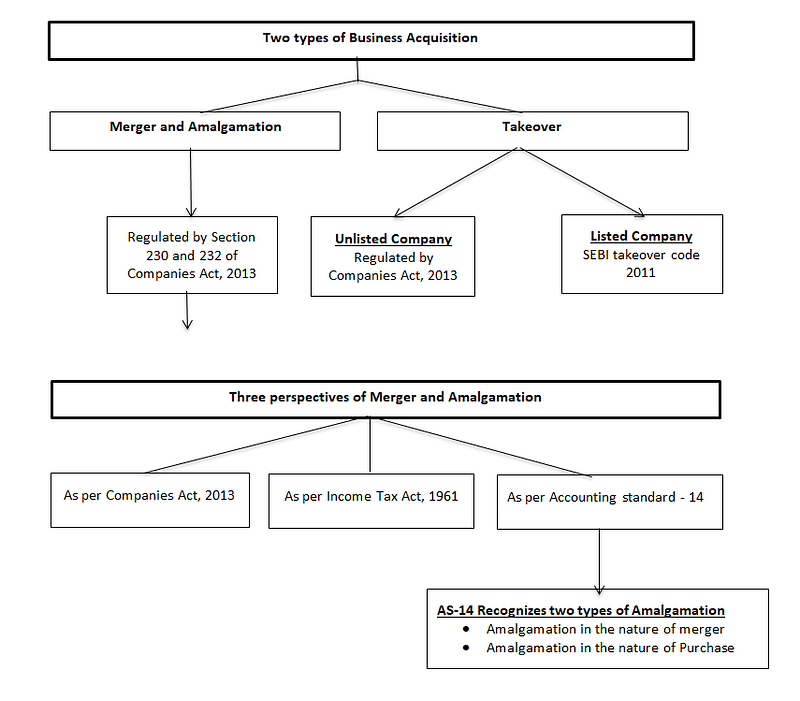
Amalgamation in the nature of merger
It affects a mode by which one company acquires another company’s assets and liabilities in such a way that, the equity shareholders of the combining entities continue to have a proportional share in the equity of the joint entity.

Amalgamation in the nature of purchase
It affects a mode by which one company acquires another company and hence, the equity shareholders of the combining entities do not continue to have an impartial share business of the acquired company is not intended to be continued after amalgamation.

Regulatory Framework of Merger & Amalgamation covers

  • The Companies Act, 2013
  • Companies (Compromises, Amalgamations, and agreements) Rules, 2016
  • Income Tax Act, 1961
  • Listing Regulations 2015
  • The Indian Stamp Act, 1899
  • Competition Act, 1899
  • FEMA
  • Banking Regulations Act, 1949
  • AS-14 Companies (Indian Accounting Standard) Rules, 2015

Difference between Amalgamation and Merger

MergerAmalgamationTwo or more companies who share parallel processes or are involved in the same line of business association to expand their services or diversify their activitiesA bigger and financially stronger entity takes over a smaller one

Horizontal, vertical, and conglomeration

Amalgamation is of two types:

· the nature of purchase and

· amalgamation in the nature of merger

Merger gives rise to a new entityThe acquiring company retains its identity while the acquired company’s identity is dissolvedThe shareholders of the companies who are parties to the merger become the shareholders of the new entityShareholders of the acquired company is added to the existing number of shareholders of the acquiring company

Legal Aspects of Merger and Acquisition

Application for making compromise and arrangement

Where a compromise or arrangement is proposed –

  • Among a company and its creditors or any class of them; or
  • Among company and its members or any class of them.

The tribunal may, on the application of the company or of any creditors or members of the company’s or in the case of a company which is being wound up, appoint the liquidator under this Act or may be under the insolvency and Bankruptcy Code, 2016, order a meeting of the creditors or class of creditors, or of the members or class of members, to be called, held and conducted in such manner as the Tribunal directs.

Submission of additional document to the Tribunal
The company or any other person, by whom an application is made shall disclose to the Tribunal by affidavit –

  • All substantial facts connecting to the company, such as the latest financial records of the company, the latest auditor’s report on the accounts of the company and the pendency of any investigation or proceedings against the company;
  • Reduction of share capital of the company, included in the compromise or arrangement;
  • Some arrangement of corporate debt restructuring concurred to by not less than seventy-five percent of the secured creditors in value, including
  • A creditor’s responsibility statement in the prescribed from;
  • Safeguarding for the protection of other secured and unsecured creditors;
  • Auditor shall deliver a report that the fund requirements of the enterprise after the corporate debt restructuring as approved shall follow to the liquidity test based upon the estimates provided to them by the Board;
  • Where an enterprises suggests to implement the corporate debt restructuring guidelines specified by the Reserve Bank of India, a statement to that effect; and

  • A assessment report in respect of the shares and the property and all assets, tangible and intangible, movable and immovable, of the company by a registered valuer.

Some other points need to be consider

  • Notice for compromise and arrangement shall be sent to all the creditors or class of creditors and to all the members or class of members and the debenture-holders of the company;
  • Voting in General Meeting for objection to compromise or arrangement shall be made only by persons holding not less than ten percent of the shareholding or having outstanding debt amount which is not less than five percent of the total outstanding debt as per the newest audited financial statement.;
  • Various authorities to who notice shall be sent along with all the documents to the Central Government, the income-tax authorities, the Reserve Bank of India, the securities and Exchange Board, the respective stock exchange, the official liquidator and to the Competition Commission of India; and
  • Special Resolution must be passed by the appropriate persons called in the General Meeting.

Power of the Tribunal
An order made by the Tribunal shall provide for all or any of the followings matters, namely:

  • When the compromise or arrangement brings for conversion of preference shares into equity shares, such preference shareholder shall be given an option to either accomplish arrears of dividend in cash or to receive equity shares equal to the value of the dividend payable;
  • The protection of any class of creditors;
  • Effects in the difference of the shareholders’ privileges under the compromise or arrangement;
  • If creditors settled the compromises, any proceedings pendant before the Boards for Industrial and Financial Reconstruction established, of the sick Industrial Companies Act, 1987 shall abate; and
  • Such other matters including departure offers to dissenting shareholders, if available, as are in the view of the Tribunal essential to effectively implement the terms of the compromise or the arrangement.

Further, tribunal shall not approved any compromise and arrangement unless a certificate by the company’s auditor has been filed with the tribunal to the effect that the accounting treatment, if any, proposed in the scheme of compromise and arrangement is in conformism with the accounting standards prescribed under section 133.

We assist our clients with all the compliances related to corporate reorganization, winding up of the company, company incorporation, business setup, ROC filings etc. If you have any questions or want to know more about corporate reorganization, kindly contact us.


Source: Corporate Reorganization


Tuesday, 15 December 2020

Who Offers The Best Company Registration Services In Delhi?


What is company registration or company incorporation?
Company Formation or Company Incorporation is that the process of registering a business as per the procedures defined by the Ministry of Corporate Affairs (MCA). The owner has the freedom to make a decision the sort of company under which the business are going to be registered. Further, Post-approval of the corporate registration process, a Certificate of Incorporation (CoI) are going to be issued to the corporate by the Registrar of Companies (RoC).

Company Registration in Delhi is viable for company formation. Additionally, registration for the corporate is completed online lately . Additionally, the registration of business may be a prerequisite to initiating business activities.

Company Incorporation or Company Registration is that the legal process to register a corporation . Once the corporate formation process has completion, the corporate becomes a separate legal entity from its owners. Moreover, after the corporate registration, it can enjoy the advantage of indebtedness , Perpetual Existence, and transferability of shares. Therefore, to avail of those benefits, the owner has got to register the corporate online.

What are the Type of Business Entities in India?
The following types of Business entitles are available in India:

  • Private Limited Company in India
  • Public Limited Company in India
  • Unlimited Company
  • Partnership
  • Sole Proprietorship

Each type of company has its advantages and disadvantages. A business owner can decide according to different factors like capital availability and decision-making capabilities etc.

Process of Company formation in India can be illustrated in following steps:
Incorporation Procedure of a private limited company is governed as per Companies Act 2013

Minimum requirement for the Private Limited Company

  • Minimum 2 Directors
  • Minimum 2 Shareholders (Directors & Shareholders can be same)
  • Minimum paid-up capital of Rs. 1,00,000/-
  • DIN for both Directors
  • Digital Signatures for all Directors
  • Consent from subscriber or director
  • Proof of Registered Address
  • NOC from the owner of the premises

The procedure for company registration can be divided into following steps :
Obtain Digital Signatures
One director must apply for the Digital Signature Certificate (DSC), which is necessary to file the company registration documents. For this, only a few scanned documents and details will be required. It is compulsory to obtain DSC for at least one Director to sign E-forms relating to incorporation life Form INC-1 and other documents.

Application for DIN in the form DIR-3
Every individual intending to be appointed as director of a company shall make an application for allotment of Director Identification Number in form DIR-3 to the Central Government in such form and manner and along with such fees as may be prescribed

Check for company name availability
Select, in order of preference, a few suitable names, not less than four, indicative of the main objects of the company. Ensure that the name does not resemble the name of any other company already registered and also does not violate the provisions of Emblems and names (prevention of improper use) Act, 1950

Application for Name Availability

  • Apply to the concerned ROC to ascertain the availability of name in INC-1 of General Rules and Forms along with a fee. If proposed name is not available apply for a fresh name on the same application the digital signature of the applicant proposing the company has to be attached in the form. MCA has prescribed certain rules for name availability, so it is advisable to check guidelines for the same before applying for name. Refer Rule-8 of Companies (Incorporation) Rules, 2014
  • After the name approval of the applicant ROC will issue Name availability Letter w.r.t. approval for availability of name for a proposed company. The name will be valid for a period of 60 days from the date on which the application for reservation was made. The applicant can apply for registration of the new company by filing the required forms INC-1 within six months of name approval.

Drafting MOA & AOA

  • Arrange for the drafting of the Memorandum and Articles of Association by the solicitors, vetting of the same by ROC and printing of the same.
  • Arrange for stamping of the Memorandum and Articles with the appropriate stamp duty.
  • Get the Memorandum and Articles signed by atleast two subscribers in his own hand, his father’s name, occupation, address and the number of shares subscribed for and witnessed by atleast one person.
  • Ensure that the Memorandum and Article is dated on a date after the date of stamping.
  • The main objects should match with the objects shown in e-form INC-1.
  • The memorandum should be in respective forms as prescribed in Table A, B, C, D and E in Schedule-1 as applicable to a company.
  • The articles should be in respective forms as prescribed in Table F, G, H, I and J in Schedule-1 as applicable to a company.

Filing various forms in ROC

  • The following documents are required to be filed with the Registrar of Companies:
  • Memorandum of Association (duly stamped) and a duplicate thereof.
  • Articles of Association (duly stamped) and a duplicate thereof.
  • Declaration by Professional in INC-8
  • Affidavit from the subscriber to the Memorandum in Form no. INC-9
  • Residential Proofs
  • Identity Proofs
  • Verification of Signature of subscribers in Form INC-10
  • A copy of the letter of the Registrar of Companies intimating the availability of the proper name.
  • e-Form №1 (with prescribed stamps) for incorporation of a Company.
  • Document evidencing payment of prescribed registration and filing fee.

Payment of form fees and stamp duty
After filing the documents of MCA online portal, we need to pay the necessary fees.

ROC verifies the forms and attachments
After the receipt of the forms along with applicable fees ROC, verifies and scrutinizes all the documents and attachments and suggests necessary changes, if require.

ROC issues the Certificate of Incorporation
If the registrar is satisfied that all the requirements have been complied with by the companies, it will register the company and issue a Certificate of Incorporation of the company. The date mentioned in the certificate is the date of incorporation of the company.

Source: Who Offers The Best Company Registration Services In Delhi?

Friday, 4 December 2020

Benefits Of Filing Income Tax Return


The rules & regulations concerning tax return filing in India are enumerated within the tax act, 1961. These rules are to be followed by every registered taxpayer who possesses a legitimate PAN card and files ITR during a fiscal year . ITR must be filed during a prescribed format and will be submitted with the tax department before the maturity so on avoid a penalty.

Gone are the times when it had been a sophisticated process of online ITR filing but now with the arrival of technology, the tax department is continuously modifying the tax return filing interface.

Different types of ITR forms which a taxpayer has got to file & benefits related to online ITR filing:

1.) Dodge the penalties & scrutiny by tax authorities
From FY 2018–19 & 2019–20; Rs 10,000 would be levied for non-filing of ITR. This penalty levy will always be there in your ITR filing record. To strengthen your ITR, one must avoid penalties and check out to file tax return on or before maturity .

2.) Improve your credit documentation process
Filing ITR will assist you in your loan application; all major banks invite a replica of tax returns prior reviewing your application for a automobile loan , consumer loan or home equity credit . as an example , the depository financial institution of India asks two-wheeler or four-wheeler loan applicants for documents just like the latest salary slip that reflects all deductions, TDS certificate/Form 16, and replica of ITR for the last two financial years. Keeping a replica of your ITR receipt handy may be a good idea if your application is rejected or if you’re getting a loan amount much lesser than what you had applied for. If you’ve got a refund due from the tax department, you’ll need to file returns so as to say the refund.

3.) Compensate losses within the next financial years
Filing of the ITR is vital as you can’t recompense your expenses & losses within the previous fiscal year to the present fiscal year . As per the income-tax provisions, if tax returns aren’t filed on time, unadjusted losses (with some exceptions) can’t be carried forward to future years.

4.) Processing of VISA
Foreign embassies, especially those of the US, UK, Canada or Europe, invite your ITR receipts of the last few years at the time of the visa interview. Some may even invite receipts of the last three years, while some others may invite the foremost recent one. ITR receipts help them assess your income and indicate that you simply are going to be ready to lookout of the expenses on the trip. They also indicate that you’re someone who isn’t leaving the country permanently but will return. Before undertaking visit a particular country, ask the respective embassies on documents that you simply should keep it up your foreign visit that country-salary slip, Form 16, and ITR receipts. These requirements may vary from one consulate to a different .

5.) Legal document
Having an ITR receipt is vital because form 16 is nothing but a politician document, entailing your income & tax charged there upon, along side revenue from other various sources. ITR receipt is shipped to your registered address, which acts as a residential proof for the taxpayer. Therefore there are multiple uses of ITR filing viz. address proof, income proof & proof of tax filing.

6.) Tax refund
There are various instances during a fiscal year during which there has been tax deducted at source (TDS) on investment. So so as to say TDS refund, one will need to file the ITR to say refund of an equivalent ,”

Source: Benefits Of Filing Income Tax Return